

Low Handicaps: 3 Keys to Elite Training at Codex Golf

There is a widespread belief in clubs and academies across Spain: when a student reaches single-digit handicap, the developmental phase is considered over and training is reduced to hours on the course. At Codex Golf we have proven that exactly the opposite happens. Low handicaps are the players who most need continuous technical supervision, because their margin for improvement no longer lies in the obvious, but in millimetric variables that can only be detected with the right methodology and technology. This article analyses, from a sports management perspective, why the best players keep training with Codex Golf and how clubs should structure their offer in order to retain them.
The problem: advanced players with no continuous improvement plan
Most golf academies in Spain and Portugal structure their training product around the beginner and the mid handicap. The consequence is direct: low handicaps migrate to solo work, sporadic sessions with an external PGA pro or, in the worst case, leave the club because they cannot find a service that matches their competitive level. For a sporting director, losing the high-end segment means losing visibility, prestige and the magnetic effect these players exert on the rest of the members.
The challenge is not to attract new low-handicap players, but to design a training pathway that justifies their loyalty. And here is the second common misunderstanding: thinking that training a single-digit player is the same as correcting their technique. Nothing could be further from the truth. Working with low handicaps is, essentially, work of auditing, fine-tuning and cognitive management.
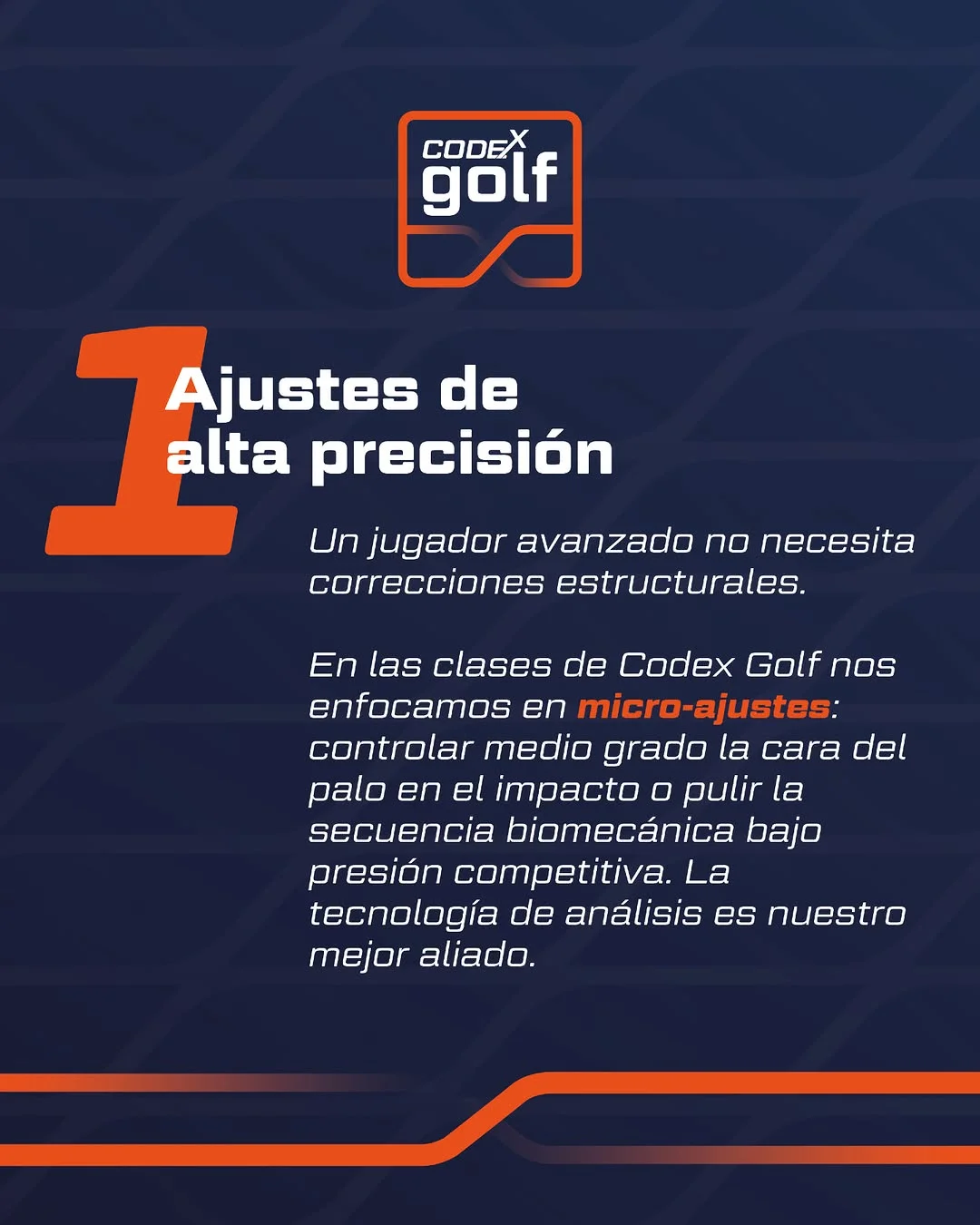
Key 1: high-precision adjustments, not structural corrections
A handicap 5 player does not need their grip changed or their swing rebuilt. They need micro-adjustments. And low handicaps only perceive those micro-adjustments when training is supported by objective data: high-speed cameras, pressure plates, ball radar and biomechanical software.
In Codex Golf sessions, work with an advanced player consists of controlling half a degree of club face opening at impact, of polishing the kinetic sequence under competitive pressure or of stabilising the angle of attack when fatigue appears. They are details invisible to the naked eye, but they translate into extra metres, into greens in regulation and, ultimately, into strokes gained relative to the handicap.
For a club or academy, offering this level of service to its elite segment requires an initial investment in indoor technology and, above all, in training the coaching team. It is the difference between a commodity service and a premium service with an associated premium rate.

Key 2: advanced course management, where the scorecard is decided
At competitive level, the game is no longer won with the club alone. It is won with the head. Low handicaps who compete on amateur or professional circuits find their best margin for improvement in course management: reading complex green maps, calculating risk percentages according to pin position and mastering scrambling to save par from compromised lies.
This training layer demands specific sessions that a standard academy programme does not cover. At Codex Golf we work with individualised plans that combine coached rounds on the course, follow-up video analysis and tournament scenario simulations. For the advanced player, this approach turns every training round into a decision-making opportunity that can be replicated under pressure.
Academy directors who want to retain this profile must understand that the training product for this profile is not sold by hourly vouchers, but by thematic blocks: mental management, strategy, short putting under pressure, bunker escape on firm greens. It is a commercial paradigm shift.
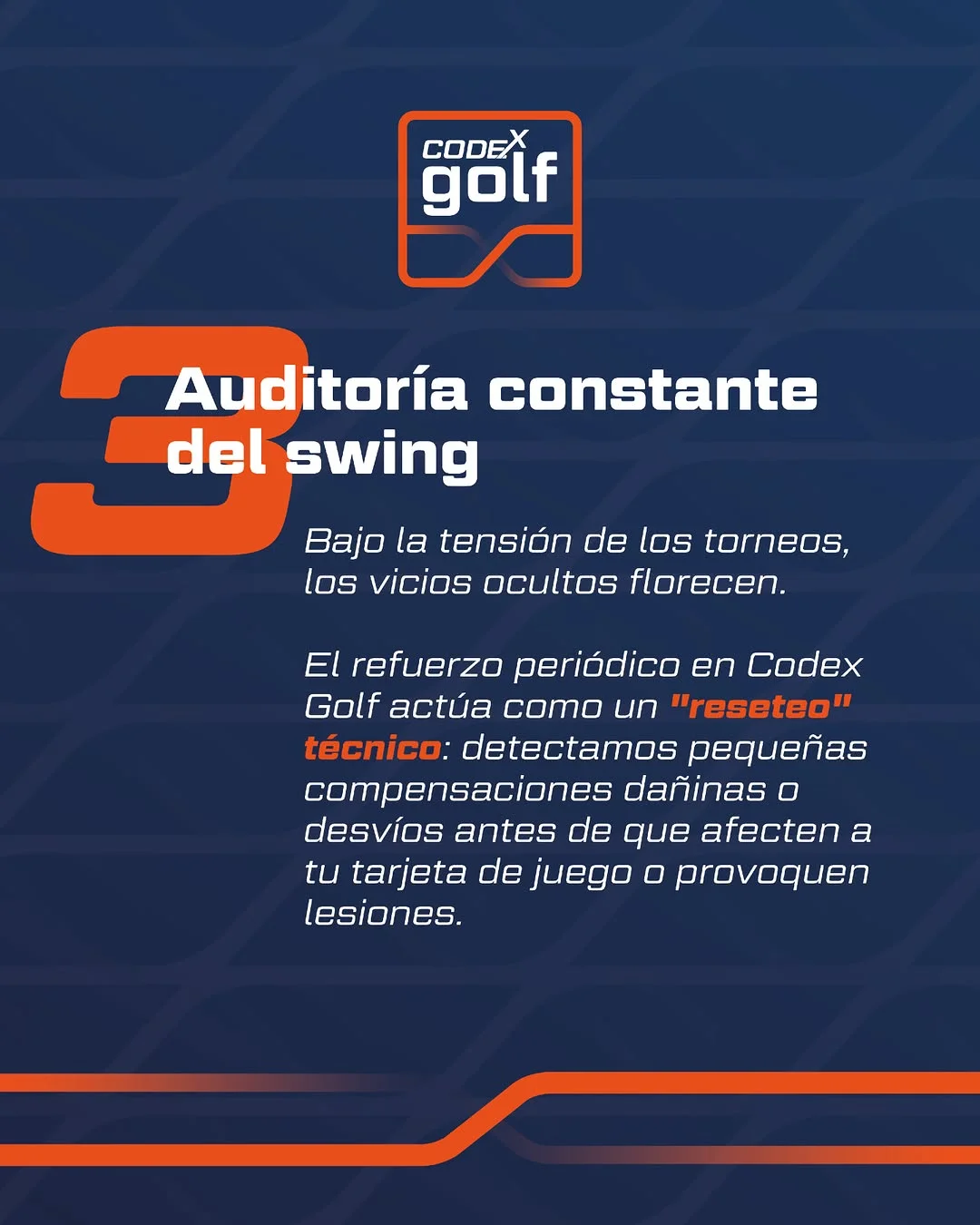
Key 3: constant swing auditing
Under tournament tension, hidden flaws flourish. A hand that closes too much on the transition, a hip rotation that falls short when water appears on the right side of the fairway, a tempo that speeds up half a second on the tee of the decisive final hole. For the single-digit player, these micro-compensations are what separate a 71 from a 75.
Periodic reinforcement acts as a technical reset. At Codex Golf we run scheduled audits every four to six weeks with our advanced players: we capture their movement, compare it against their baseline and detect deviations before they affect the scorecard or, worse, cause injuries through repeated compensations over time.
For sporting management, this ongoing audit service is the formula with the highest documented retention rate in the low handicaps segment. It is also the reason an elite player accepts paying an annual training fee that doubles the club’s standard rate: they perceive measurable value.
How to structure a low handicaps programme at your club
If you manage an academy or a course and want to position yourself as a reference point for low handicaps, it is worth building the pathway on three operational pillars:
- Initial technological diagnosis: biomechanical baseline, ball radar and mental test. It is the opening contract.
- Monthly micro-adjustment sessions: 90-minute blocks in the indoor bay with quantitative analysis and a task plan for the course.
- Quarterly tournament audit: follow-up in real competition, with a coach accompanying one round and post-round debriefing.
This model not only retains your current elite players; it also turns your club into a destination for players from neighbouring clubs who cannot find this level of service at their own venue. The effect on the internal ranking and on attracting local sponsorship is direct. If you want to explore how to implement this model at your academy, you can contact the Codex Golf team for an initial consultation with no commitment.
The professional sector also endorses this approach: the PGA of Spain recognises continuous education as a differentiating element in any programme aimed at high-level amateur competition.
Frequently asked questions
What is considered a low handicap in Spain?
Usually, low handicaps are players with an index below 9.9 (single digit). In the high-level amateur competition segment the functional cut drops to handicap 5 or lower, and that is where the Codex Golf methodology delivers the most.
Why does an advanced player need to keep training?
Because the margin for improvement shifts from gross technique to fine-tuning. Without periodic auditing, the advanced player accumulates unconscious compensations that erode their tournament consistency and increase the risk of injury.
How does a club monetise services for low handicaps?
Through premium annual packages that include technological diagnosis, monthly sessions and tournament auditing. The average fee per elite player doubles the standard training ticket and generates a much higher margin per coaching hour.
How long does a low handicaps programme take to show results?
The first quantitative indicators (proximity to the pin, strokes gained with the driver) usually appear between the sixth and tenth week. Consolidation in tournament play, where elite work is truly validated, typically arrives at the close of the first full season.