
Swing diagnosis with sensors: Codex Golf’s method for low handicaps
When a player locks in a handicap below 10, lessons based on feel or on copying the swing of a TV professional stop delivering results. At that level, every point of improvement demands a swing diagnosis with measurable parameters: knowing precisely what the body does at each phase of the movement and why the ball behaves the way it does. At Codex Golf we have built our lessons for advanced players on that foundation, with a learning system grounded in movement science. In this article we explain what it involves and how it is applied in each session.
Why feel-based lessons run out of road at low handicaps
Traditional teaching works in the early stages: the coach observes, the student tries and the most obvious errors are corrected by eye. The problem appears when the margin for error narrows. The faults of a low-handicap player are no longer visible to the naked eye: they hide in pressure transfer, in body angles and in how the mechanics respond when something is at stake.
That is where the swing diagnosis makes the difference. Instead of guessing at what seems to be happening, we measure what actually happens and work from data. Our method is built on three pillars that follow a deliberate order: first measure, then correct and, finally, put the result under pressure.
Pillar 1 — Swing diagnosis through biofeedback
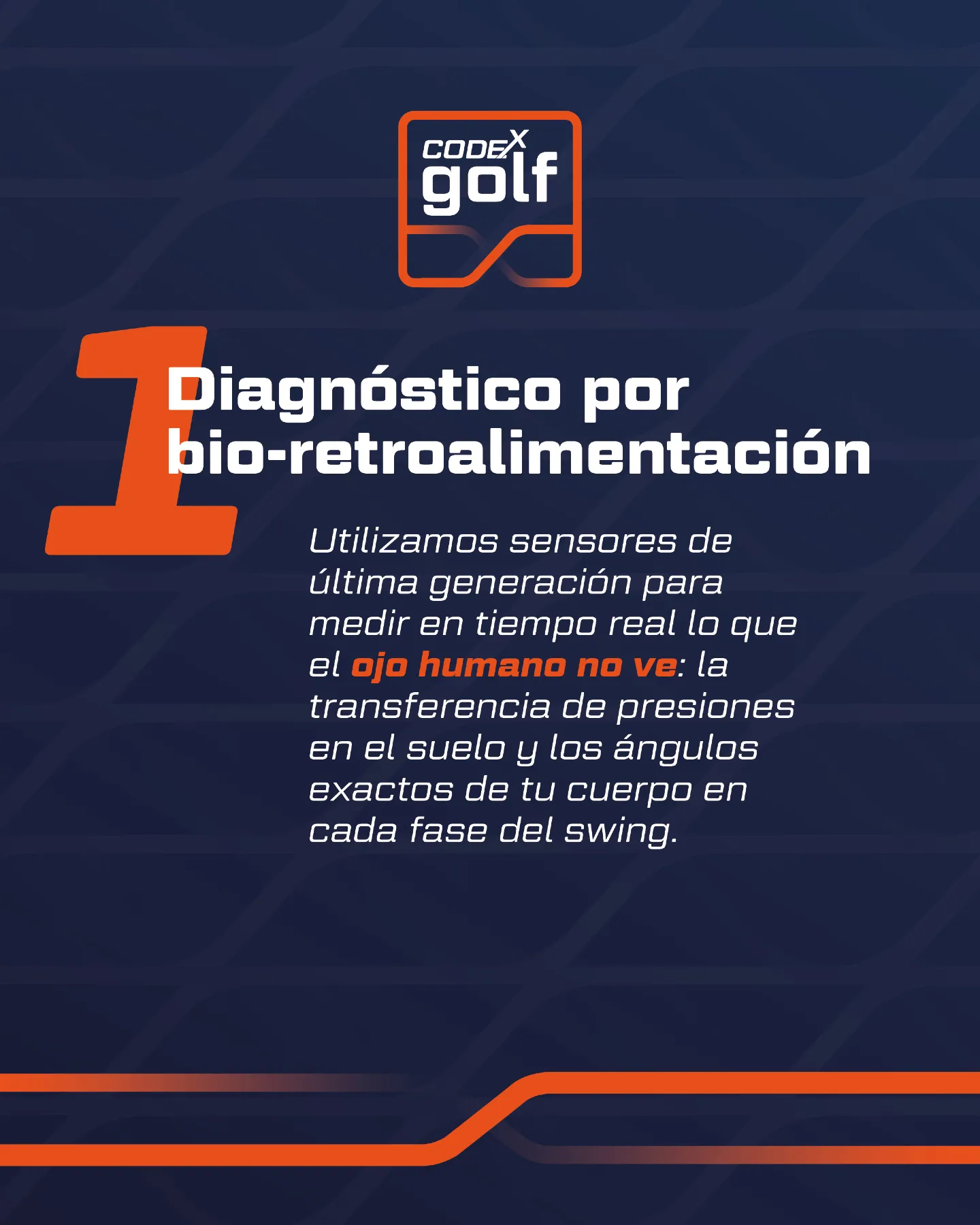
The starting point is a swing diagnosis carried out with state-of-the-art sensors that measure in real time what the human eye cannot see: the transfer of pressure into the ground and the exact body angles at each phase of the swing. That information turns the lesson into something closer to a clinical consultation: before touching anything, we identify with precision where the performance is leaking away.
For the player, the change is immediate. Conversations stop revolving around impressions — “I think I’m getting stuck behind”, “I feel like I’m opening the face” — and start resting on objective records that coach and student see at the same time. Measurement removes the ambiguity and makes it possible to prioritise: we work first on what most affects the shot, not on what draws the most attention.
Pillar 2 — Corrective exercises designed to measure
Data with no action plan changes nothing. That is why the second pillar translates the swing diagnosis into specific corrective exercises. We do not hand out generic advice: we create personalised drills for each player’s physique, with the aim of consciously and efficiently automating the correct movement.
That personalisation is what sets a structured training programme apart from a one-off lesson:
- It starts from data, not hunches: each drill responds to a fault detected in the measurement.
- It adapts to the player’s body: the correction respects the physique of the person performing it, rather than forcing an alien mould.
- It aims for automation: the goal is not to understand the correct movement, but to embed it until it comes out on its own.
Pillar 3 — Competitive pressure simulation
The third pillar takes the technique into the real environment. A flawless swing on the practice range is of little use if it falls apart on tournament day. That is why we design dynamics and challenges within the lesson itself to monitor how the player’s mechanics respond under the tension of the scorecard.
That work closes the loop opened by the swing diagnosis: what was measured and corrected under controlled conditions is put to the test in situations that reproduce the demands of competition. The result is a swing shielded for tournament days, when it truly counts.
A sequential method, not a collection of lessons
The three pillars are not independent services: they form a sequence. Without the initial measurement, the drills would be generic; without the drills, the swing diagnosis would remain a report with no consequences; without the simulated pressure, the improvement would not survive the first competitive Saturday. It is the same logic that any high-performance discipline applies: evaluate, intervene and validate in a real context.
For the low-handicap player, the swing diagnosis solves the most common frustration at that level: training hard without knowing whether they are training the right thing. With measurable parameters, every session has a concrete objective and progress can be verified, not merely sensed.
Where and how to take the next step
If you play below handicap 10 and feel that conventional lessons no longer move the needle, a swing diagnosis is the most direct way to find out what is holding you back. You can get to know our facilities in Burgos or get in touch with the Codex Golf team to discuss your case and arrange a first assessment session.
Frequently asked questions about the swing diagnosis
What is the swing diagnosis through biofeedback?
It is an assessment with sensors that record in real time the transfer of pressure into the ground and the body angles at each phase of the swing. It provides objective data the human eye cannot capture and serves as the basis for the entire training plan.
What level of play is this method designed for?
It is especially suited to players with a handicap below 10, whose room for improvement can no longer be spotted with the naked eye. That said, any player who wants to train on measurable parameters can benefit from a swing diagnosis.
How does it differ from a conventional golf lesson?
A conventional lesson relies on observation and feel. Here the swing diagnosis precedes any correction: first we measure, then we design tailored corrective exercises and, finally, we put the technique under simulated competitive pressure.
How can I book an assessment session?
Write to us through the Codex Golf contact page and we will guide you through the next steps to schedule your first assessment session.