Golf sponsorship: how to connect clubs, brands and players
Golf is a network of opportunities. This is how we turn sponsorship into a deal that fills tee times, takes brands to their audience and frees the player to compete.


Golf is a network of opportunities. This is how we turn sponsorship into a deal that fills tee times, takes brands to their audience and frees the player to compete.
Before executing a golf project it pays to validate it: a feasibility study analyses market, technical, financial and regulatory factors to answer whether it is worth investing.
The three management metrics every golf club should track to make better decisions: occupancy rate, green fee revenue and member and visitor satisfaction.
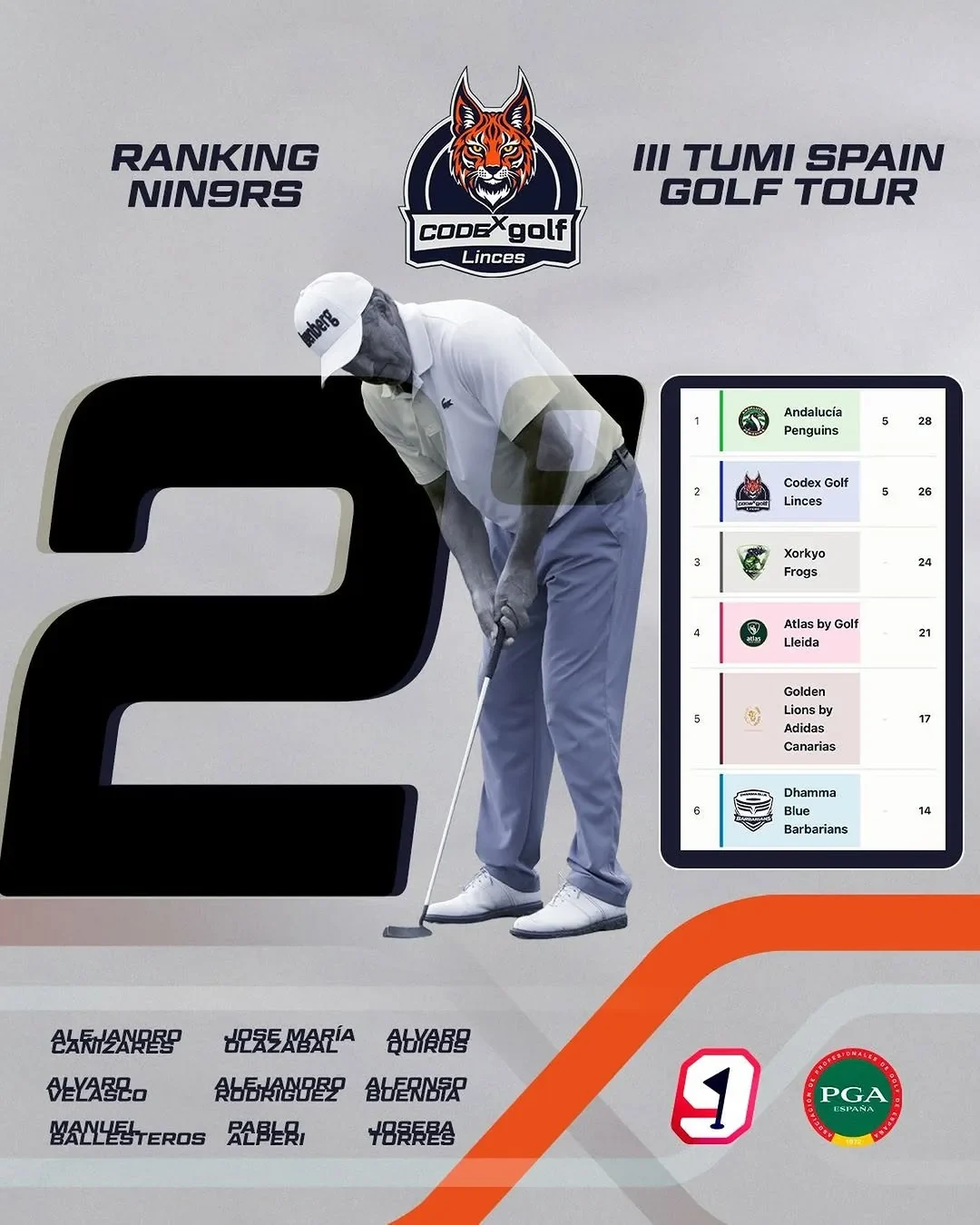
Codex Golf Linces secure 2nd place in the NIN9RS ranking of the III TUMI Spain Golf Tour after the V Bizkaia PGAe Open: a sharp read on the sporting and commercial model.
From classes to strategy: how to build a profitable golf academy with revenue, technology, loyalty and positioning that actually scale.
Making golf sponsorships profitable is one of the biggest challenges in modern commercial management. Today, the sector suffers from a commercial “myopia”: for many clubs, finding a sponsor is the equivalent of passing the collection plate at mass just to plug holes in the annual budget. The outcome is predictable: 80% of golf sponsorships are not renewed.
Most agreements fail because they rely on passive visibility. The club sells space (a sign on the 1st tee, a banner on the driving range), and the brand expects it to magically translate into sales. These poorly executed golf sponsorships generate frustration for three main reasons:
Today, brands are moving away from traditional advertising noise. What they seek in golf sponsorships is context and access:
To make sponsorships a long-term asset, we must move toward strategic integration models:
The brand funds a tangible improvement that members appreciate—for example, a premium hydration station or upgraded halfway house furniture. The brand becomes a facilitator of a better playing experience.
The sponsorship extends beyond the physical course. It is integrated into the club app, newsletters, and booking systems, enabling real interaction data and exclusive benefits for members.
The club becomes the sponsor’s business hub, offering corporate golf clinics or boutique tournaments that strengthen company culture and public relations.
We recently reviewed a common case: a financial institution with a faded banner on hole 9. Nobody looked at it, nobody remembered it.
The Codex transformation: We removed the banner and created a tournament circuit under a high-impact golf sponsorship model. The brand didn’t just attach its name—it delivered short wealth management insights during the cocktail reception and offered a digital swing analysis to every participant.
Result: The club increased sponsorship revenue by 40%, and the brand renewed for three years after acquiring 15 new qualified leads in a single event.
Stop sending generic brochures with advertising rates for signage. If you want your golf sponsorships to be seen as strategic investments, follow this process:
Golf coach at golf courses retention strategy is one of the most decisive—and least leveraged—factors in Spain’s golf industry.
There is a role at almost every golf course that knows the members better than anyone. They know who hasn’t shown up for months, who is about to leave, who has just started, and who brought their child for the first time.
They have direct access to the player at the moment of greatest receptiveness: when they are focused, engaged, and willing to improve.
That role is the golf coach.
And yet, at most courses they are still treated as just another external supplier—on the same level as any ancillary service.
The standard model in the industry is simple:
There is no joint strategy, no shared objectives, and no structured follow-up.
The result is clear: golf coach at golf courses retention strategy is completely underutilized.
The course loses control over one of the member’s most relevant experiences, and the coach operates without support or integration.
An active golf professional generates far more value than what appears on any profit-and-loss statement.
A player who trains regularly plays more, improves more, and stays connected to the club for longer.
In many cases, the relationship with the coach is the primary bond with the course.
Each new student represents an acquisition opportunity.
In practice, the coach is the first point of contact with the club for many golfers.
The professional recommends equipment, tournaments, practice packages, and facilities.
They do so with a critical advantage: trust and timing.
When a player talks about their course, they talk about their coach.
The credibility of that recommendation is higher than any commercial action.
The mistake is not operational; it is conceptual.
Historically, coaching has been treated as a complementary service, not as a strategic line.
From that logic, outsourcing seems efficient.
But it ignores a critical reality: coaching is one of the main levers for retention.
A course without a training strategy has no retention strategy.
And this is where golf coach at golf courses retention strategy makes sense as a central pillar.
There is no need to change the contractual model. What needs to change is the relationship.
Set commissions when a student becomes a member or increases their activity.
The coach has critical information about player behavior.
Not integrating it into decision-making is a strategic mistake.
The professional should have a presence in:
Humanizing the academy increases conversion.
Clinics, student tournaments, beginner days.
The coach brings expertise; the course provides structure and visibility.
When was the last time you spoke with the coach about what is happening with your players?
If the answer is “never” or “a long time ago,” you are operating with incomplete information.
Golf coach at golf courses retention strategy is not an external resource. It is the closest point to the customer within the club ecosystem.
The academy is not a service. It is a business tool.
Integrating the coach into the course’s strategy makes it possible to:
Ignoring this asset is leaving value on the table.
And in an increasingly competitive environment, that is a luxury few courses can afford.
At Codex Golf, we work with courses and academies to develop efficient, sustainable collaboration models.
You can also visit us in person at Codex Golf and discover our facilities:
Profitable golf driving range.
That’s how any well-managed driving range should operate. However, in many golf clubs across Spain, the reality is quite the opposite: a facility that consumes resources every single day but generates little to no revenue by the end of the month.
It has turf, maintenance, infrastructure… and yet, it shows up on the books as a cost, not an asset. And in most cases, that’s because it isn’t being managed as a truly profitable golf driving range.
What’s most striking is that this is probably the most underutilized revenue opportunity within the entire club.
The issue usually isn’t the facility itself. It’s how it’s perceived.
For years, driving ranges have been treated as a support service: a place where players warm up before a round or where beginners hit their first balls. Something that “needs to be there,” but not necessarily something expected to generate revenue.
That mindset limits its potential from day one—and makes it almost impossible to turn it into a profitable golf driving range.
Once you start seeing it as a standalone product—with its own audience, pricing structure, and business logic—the entire picture changes. And so do the results.
If you look across different facilities, most driving ranges fall into one of these three categories:
It exists, but no one is really tracking it. There’s no clear data on usage, no revenue monitoring, and occupancy is inconsistent. Financially, its impact is almost nonexistent.
There is activity—some lessons, some ball traffic—but it fully depends on the rest of the club. It lacks its own strategy, which keeps its potential capped.
This is where the real difference lies. A profitable golf driving range is managed as a business unit: defined products, structured pricing, events, and continuous data tracking.
It’s not about the facility. It’s about the approach.
One of the most common mistakes is including range usage within general membership. This removes its perceived value as a standalone offering.
When dedicated practice memberships are introduced, a new type of customer emerges: players who want to improve, beginners, or golfers who don’t play full rounds regularly but practice often.
One-off lessons have limitations. Structured group programs—with defined duration, consistency, and progress tracking—create predictable revenue and improve retention.
It’s not about selling a lesson. It’s about selling a process.
Some hours are full… many are empty. Dynamic pricing based on time slots helps balance occupancy and increase overall revenue without major operational changes.
A driving range is far more flexible than a full course. It allows for clinics, competitions, and corporate events without complex logistics.
Beyond direct revenue, it increases visibility and brings new audiences into the club.
Range bays, signage, and equipment are natural branding spaces. While not the main revenue source, they represent an additional and often underused income stream within a profitable golf driving range.
A profitable golf driving range is not built on intuition—it’s built on data.
At a minimum, you should be tracking:
If you don’t have this data, you’re not managing the facility—you’re just maintaining it.
There’s one strategic role many clubs overlook: the driving range is often the first real touchpoint with golf.
It’s accessible, quick, and far less demanding than playing a full round. That’s why beginners and new players start there.
When managed properly, a profitable golf driving range doesn’t just generate revenue—it feeds the entire ecosystem: lessons, memberships, and course activity.
If you want to explore how to turn your facility into a real asset, you can contact our team and take a closer look at your specific case.
You can also visit us in person at Codex Golf and discover our facilities:
Because in the end, the difference isn’t having a driving range. It’s whether you’ve actually turned it into a profitable one.
The junior golf program is not an extracurricular activity.
It is the most profitable acquisition strategy your club has (and the one you neglect the most).
In most golf clubs in Spain, the junior golf program exists simply because “it has to be there.” It is an activity offered, communicated on the website, and included in the facilities brochure. But it rarely forms part of the club’s strategic plan. It rarely has measurable acquisition goals. And it is almost never managed as what it really is: the business line with the highest long-term return a golf facility can have.
Changing this perspective does not require large investments. It requires understanding the logic behind it.
A child who starts playing golf at eight years old and has a positive experience within a well-structured junior golf program does not look for another club when reaching adulthood. They already have theirs. They already have their community, their memories, and their golfing identity linked to your facility.
The cost of acquiring that adult member is practically zero. You acquired them ten years ago with a junior academy fee. What most clubs do not calculate is the total lifetime value of that customer: decades of membership fees, tournaments, lessons, equipment, restaurant spending, and, eventually, their own children in your academy.
When that calculation is done, the junior golf program stops appearing as a cost and begins to be seen as what it really is: an investment with extraordinary return and a time horizon no adult acquisition campaign can match.
There is something clubs that manage their junior golf program well have learned, and others usually ignore: children do not come alone. They come with parents. And parents observe, ask questions, take interest, and frequently end up taking lessons themselves.
Golf has a high entry barrier for adults unfamiliar with the sport. It is intimidating, seems expensive, seems difficult. But the parent who brings their child to a well-run junior academy has already crossed the threshold. They are already inside the club ecosystem. They have already seen that the environment is welcoming, that the professional knows what they are doing, and that the experience is worthwhile.
That parent is the most qualified potential member there is. And acquiring them costs almost nothing if the junior golf program is well designed.
There is no single way to monetize and structure a junior golf program. These are the three models that generate the best results:
Group lessons by handicap level and age, with clear progression and periodic evaluations. The student knows where they are and where they are going. Parents see progress and have reasons to renew. This model generates high retention and facilitates upselling to individual lessons.
Summer intensives, Christmas camps, and internal junior tournaments. These are high-visibility activities that generate concentrated revenue, attract new profiles, and build community among students. A well-executed campus retains existing students and attracts those on the waiting list.
For clubs with a focus on sports excellence. Identify talent, develop it with a personalized plan, and showcase the results. Each junior competing at regional or national level is the best selling point for the program. The visibility it generates on social media and local media is impossible to buy with an advertising budget.
It is not the number of students. Nor the quality of the facilities. The difference between a junior golf program that grows and one that stagnates is almost always the same: communication with parents.
Parents decide whether their children continue. Parents recommend or do not recommend. Parents are the ones who post on social media when their child makes a good score. And parents are the first to leave if they do not feel the club cares about their child’s progress.
A monthly progress report, fluid communication with the professional, an internal tournament where children can compete and parents can watch their children in action: these three things, well executed, have more impact on junior retention than any facility improvement.
The junior recruitment season in Spain is concentrated in the months before summer and in September. Clubs that arrive at these dates with a structured, communicated junior golf program and defined spots fill up. Those who improvise on the fly have empty waiting lists and small groups that do not cover costs.
Structuring the program does not mean making big changes. It means defining groups, schedules, prices, family communication, and acquisition goals before the season begins. It means being clear about what is offered, to whom, and at what price.
The junior golf program is not a secondary line. It is the most efficient growth engine a club can have if managed correctly.
At Codex Golf, we work with academies and clubs to design and structure junior programs that generate measurable results: more students, higher retention, and greater impact on adult membership acquisition.
If you want to analyze how your current program is performing and what can be improved, you can contact us here.
Visit us in person and see our facilities: Google Maps.
For decades, golf academies in Spain have followed the same calendar: peak season from March to October, a drop in November, hibernation in December and January, and then a return in spring with the same students and, if lucky, a few new ones. It was an accepted model simply because it was the only one available.
Indoor golf has completely disrupted that logic. Yet many academies that have installed a simulator or an indoor space still treat it as an off-season extra, instead of recognizing it for what it truly is: a lever to completely redesign their business model.
When an academy installs a golf simulator, the conversation usually revolves around technology: brand, software, data accuracy. These are legitimate questions, but not the right ones if the goal is to generate real revenue. The right question is: what product am I going to sell with this, and to whom?
A simulator without a structured commercial offering is just an expensive piece of equipment used when it rains. With a well-designed product, it becomes an active revenue stream 365 days a year, regardless of weather or daylight.
In Spain, demand drops when some high-income profiles have the most free time: December and January. Parents, executives, and groups of friends are looking for quality experiences during this period. Academies that understand this see winter not as a threat but as an untapped demand segment.
Many academies install simulators without first defining their commercial offer, pricing, formats, or communication strategy. The result: irregular use, low income, and a perception of expense rather than investment. The simulator doesn’t sell itself; what generates revenue is the product built around it.
Demand for indoor golf is growing in Spain. Players recognize that data analysis and training in a controlled environment are key to serious technical development. Academies that define their indoor offering now will secure a strategic position against their competitors.
At Codex Golf, we work with academies and clubs to design the commercial proposal for their indoor spaces: from product definition to communication and recruitment strategy. If you have a simulator that isn’t performing as expected, or you’re planning to install one, contact us here.
Visit us in person at Codex Golf and explore our facilities: Google Maps