

Golf Course Feasibility Study: How to Validate Your Investment

Launching a new course, expanding an academy or undertaking a major investment without a prior feasibility study is, in practice, betting blindly. Before executing any project, it pays to analyse its potential with a strategic and technical eye that answers a single question: is it worth investing in? That is the purpose of a feasibility study and the starting point of every well-grounded decision in the golf industry.
What is a feasibility study in a golf project?
A feasibility study is a rigorous analysis that measures, before committing resources, whether an idea can become a profitable project that is sustainable over time. It is not an exercise in intuition or an optimistic forecast: it is a diagnosis that cross-references market data, technical constraints and economic projections to determine, with sound judgement, whether the project holds up. In a sector with high investments and long timelines like golf, that analysis marks the difference between a backed decision and a leap into the void.
Applied to a course, an academy, an indoor technology centre or a refurbishment of facilities, this analysis translates an ambition into numbers and scenarios. It helps directors and managers speak the same language as their boards and their financiers: the language of evidence.
What it is for: validating before executing
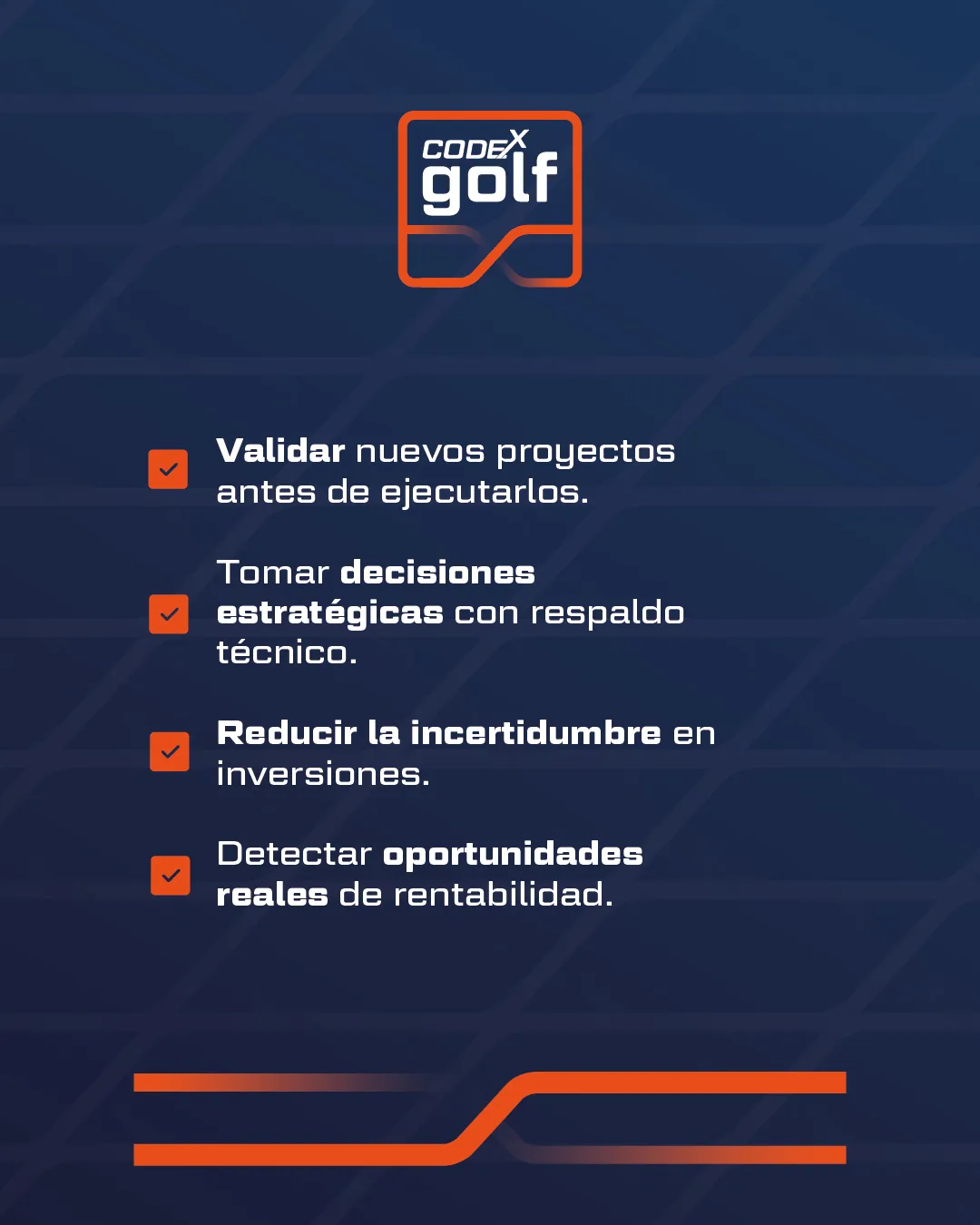
The value of a feasibility study lies as much in what it prevents as in what it drives. Before moving the first line of the budget, this work makes it possible to take better decisions on four specific fronts:
- Validate new projects before executing them, confirming that the idea has real traction.
- Make strategic decisions with technical backing, and not on hunches.
- Reduce uncertainty in investments that commit resources for years.
- Detect real profitability opportunities that go unnoticed at first glance.
Put another way, this work turns an emotional decision into a measurable one. A project that passes the analysis sets off with a solid roadmap; one that does not pass is discarded in time, saving a far greater cost later on.
Which dimensions we analyse
A complete feasibility analysis is not limited to the profit and loss account. For the conclusion to be reliable, the analysis is approached from several angles that reinforce one another:
Market viability
Potential demand, the profile of players and members, competition in the area and seasonality are studied. Without demand that sustains the investment, no financial projection is met.
Technical viability
This covers the condition of the terrain, the requirements of the facility and the technology needed to operate with guarantees. It is the part that confirms that what you want to build can be built and maintained.
Economic and financial viability
This is where the feasibility study projects revenue, operating costs, initial investment and payback periods. With different scenarios —conservative, realistic and optimistic— the manager sees the range of possible results, not a single isolated figure.
Legal and planning viability
No project moves forward if the regulatory framework does not allow it. Verifying licences, land use and environmental obligations avoids surprises capable of halting an investment already under way.
From data to decision: how we work at Codex Golf
At Codex Golf we approach every feasibility study with the mindset of someone who is going to operate the project, not just analyse it. We start from the real objectives of the club or the investor, we gather the available data and we complete it with our experience in managing golf facilities. The outcome is not a report that gets filed away, but a decision-making tool: clear scenarios, identified risks and actionable recommendations.
That approach means the study serves what truly matters: deciding with confidence. A validated project moves forward with confidence and solid backing before financiers; a project with doubts is reconsidered before the cost becomes irreversible. In both cases, the organisation wins. If you are weighing a new investment or an expansion, you can tell us about your project and study its potential together; you will find us at our offices in Burgos.
Investing in golf demands capital, time and vision. A feasibility study does not eliminate risk, but it puts it on the table before it is too late, and that is precisely the work that separates a gamble from a strategic decision.
Frequently asked questions about the feasibility study
When should a feasibility study be carried out?
Before committing resources: when planning a new course or academy, an expansion, a major refurbishment or the introduction of technology. The earlier it is done, the greater its ability to avoid unnecessary costs.
How does it differ from a business plan?
The feasibility study answers whether the project is achievable and profitable; the business plan develops how to execute it once that viability is confirmed. The former is the precondition of the latter.
Is it only useful for new projects?
No. It is also very useful for deciding on expansions, changes of business model or major investments in existing facilities, where uncertainty is also high.
What do I receive at the end of the process?
An analysis with economic scenarios, identified risks and a clear recommendation that allows management to take a decision backed by data.